


Upskilling Generation Net Zero (GenNZ) ‘Summer School’ 2025 (English version)
Thu 1st May 2025 - Mon 30th June 2025
The GenNZ Summer School is the pilot teaching programme to test, evaluate and amend the design of a new approach to teaching ‘green management skills’ for making the transition to ‘sustainable tourism’ happen… and make that change happen quickly!

GenNZ is an Erasmus+ project, administered by the Greek National Agency IKY/ Εθνικ Μονάδα Συντονισμού, and co-funded by the EU.
Partners: GenNZ Project Leader is the European Sustainability Academy (ESA) Crete, with Partner Entrepreneurship Movement Club (EMC) Slovenia.
As the 2 participating countries are Greece and Slovenia, the ‘Summer School’ will be delivered in Greek and Slovenian with case studies and examples from each country to make the content relevant for the learners. Some teaching material will be in English with subtitles where possible or may require translation by online tools.

The teaching design has been built on:
Stage 1. An extensive study including academic and practitioner literature reviews on:
- Education in tourism across Europe and beyond
- The current state of ‘sustainable tourism’ in Europe
- Notable advancements and market movers in ‘sustainable tourism’.
Stage 2. A survey with 300 respondents from Greece and Slovenia to identify the current state of understanding of ‘green skills’ in tourism.
Focus groups of more than 20 invited experts and practitioners to explore the findings of the survey. The focus groups helped to gain more understanding about what teaching and support is needed by professionals in the tourism and hospitality sectors in Greece and Slovenia for developing their own competencies towards economically viable sustainable tourism models.
We LISTENED to, and MADE SENSE of, EVERYTHING FROM STAGES 1 and 2.
WE HEARD WHAT TOURISM and HOSPITALITY SECTOR PROFESSIONALS ASKED FOR.
Intended Learning Outcome: Attendees are expected to leave ‘revitalised’ with new ideas and a practical toolkit of techniques and actions for applying their newly learned Knowledge Skills and Behaviours (KSBs) at work to enhance and strengthen their business through economically viable actions which make sense to the organisation and its customers.
View project progression and outcomes
Cost: This ‘Summer School’ is funded through the Erasmus+ Project and is FREE to attend.
Attendees: A total of 20 attendees only will be accepted from each country. Attendees will be accepted based on their roles in the tourism and hospitality sectors or education of those sectors. Attendees should come from the project target groups (see Outline).
Optional: There will be an Invitation for ‘Summer School’ learners to attend, in person, live, end of project and ‘GenNZ graduation’ events and celebrations in Athens and at the ESA sustainability management and leadership training centre in Crete in September 2025.

Key Aims of the GenNZ Summer School course
Overarching aim of the GenNZ project is to clarify what ‘green management skills’ are, with a specific focus on roles in the tourism and related hospitality sector.
The overarching objective is to develop a complete, ready to use, ‘green skills’ vocational competencies (knowledge, skills and behaviours) framework and teaching programme, with assessment and micro-credentials, which is grounded in workplace reality. This is to address the gap between Vocational Education Training (VET) green skills development and the fast-changing world of work towards net-zero.
The 2 main focus areas for impact are:
- Employment and the required skills in the future of work towards a ‘green transition’
- Upskilling workers and entrepreneurs in the tourism and related hospitality sector
Objectives aligned with EU policy making:
HORIZONTAL: Environment and fight against climate change
VET: Adapting vocational education and training to labour market needs
VET: Increasing the flexibility of opportunities in vocational education and training
Topics aligned with EU policy making:
- Overcoming skills mismatch and addressing the needs of the labour market
- Green skills
- Work-based learning
GenNZ Project Activities:
Activity 1. Research and scoping study. A survey to identify the status quo and skills matching gap (September – October 2024).
Activity 2. Green Skills Focus Groups of experts and practitioners to inform the teaching design (November – December 2024).
Activity 3. Training module design with workplace learning and evidence based assessment (January – March 2025).
Activity 4. Training pilot activation – summer school with access to tourism workplaces (April – June 2025).
Activity 5. Post pilot workshops and dissemination in Greece and Slovenia (July- August 2025).
Activity 6. Project closing conference and evaluation (September 2025).
About the ‘Summer School’ course:
The GenNZ ‘Summer School’ is Activity 4. In the GenNZ project. It will run over 8 weeks between May and June 2024. The course has been designed to be:
- Workplace relatable (role relevant)
- Location relatable (Greece, Slovenia)
- Easy to access (on demand)
- Short – bite-size content
- Modules ‘pick and mix’ format
- No-cost for the pilot and Free/ low-cost use after the project end
- Practical step by step guides with case studies and real examples
- Reflective for applying the learning content to the workplace in a meaningful way
- Horizon scanning for future proofing
- Micro-credential certified (portable digital credentials)
Key Aim of the GenNZ ‘Summer School’
The course is a pilot of new teaching materials and a programme design which aims to make teaching ‘Green Skills’ in the tourism and hospitality sector more accessible to greater numbers of people and be workplace relatable and practical.
The ‘Summer School’ programme has been designed through building on what tourism and hospitality business owners, managers and employees; tourism membership bodies; tourism educators and aspirational tourism employees have told us they want.
Detailed Intended Learning Outcomes: View project progression and outcomes
Learning format: The GenNZ ‘Summer School’ follows ESA’s usual ‘action learning’ format which is always grounded in mutual and respectful peer group exchange. Facilitators and guest speakers are selected because of their relevant and extensive experience. Open discussions are encouraged in the understanding that every person has new ideas, experiences and ‘top tips’ to share. Every voice is heard and participants all learn and develop new knowledge and skills together.
Participants: 20 applications from Greece and 20 from Slovenia will be accepted from people from the target groups for the project, which includes both learners and teaching providers:
4 Core Target Groups for Participants:
- Youth (18-30) | newly graduated, unemployed, existing employee, entrepreneur
- Mid-career (30 plus)| unemployed, existing employee, entrepreneur
- Mid-career change with desire for enhancing and futureproofing workplace competencies
- VET Educators
Sector: Tourism and hospitality, Employers, Employees, Recruiters and Careers Advisors, HR professionals and Tourist boards
Other groups from which applicants will be welcomed:
- Small artisan businesses, micro & SMEs
- Cultural & heritage tourism groups
- Policy Makers
- Selected NGOs & Environmental Organizations
- Vocational Training Centres
- Regional & national chamber commerce
We welcome 20 participants who will help us to test and improve this framework for meeting our GenNZ project objective to:
‘… develop a complete, ready to use, ‘green skills’ vocational competencies (knowledge, skills and behaviours) framework and teaching programme, with assessment and micro-credentials, which is grounded in workplace reality.
With the potential to address the gap between Vocational Education Training (VET) green skills development and the fast-changing world of work towards net-zero’.
GenNZ Summer School Pilot Programme
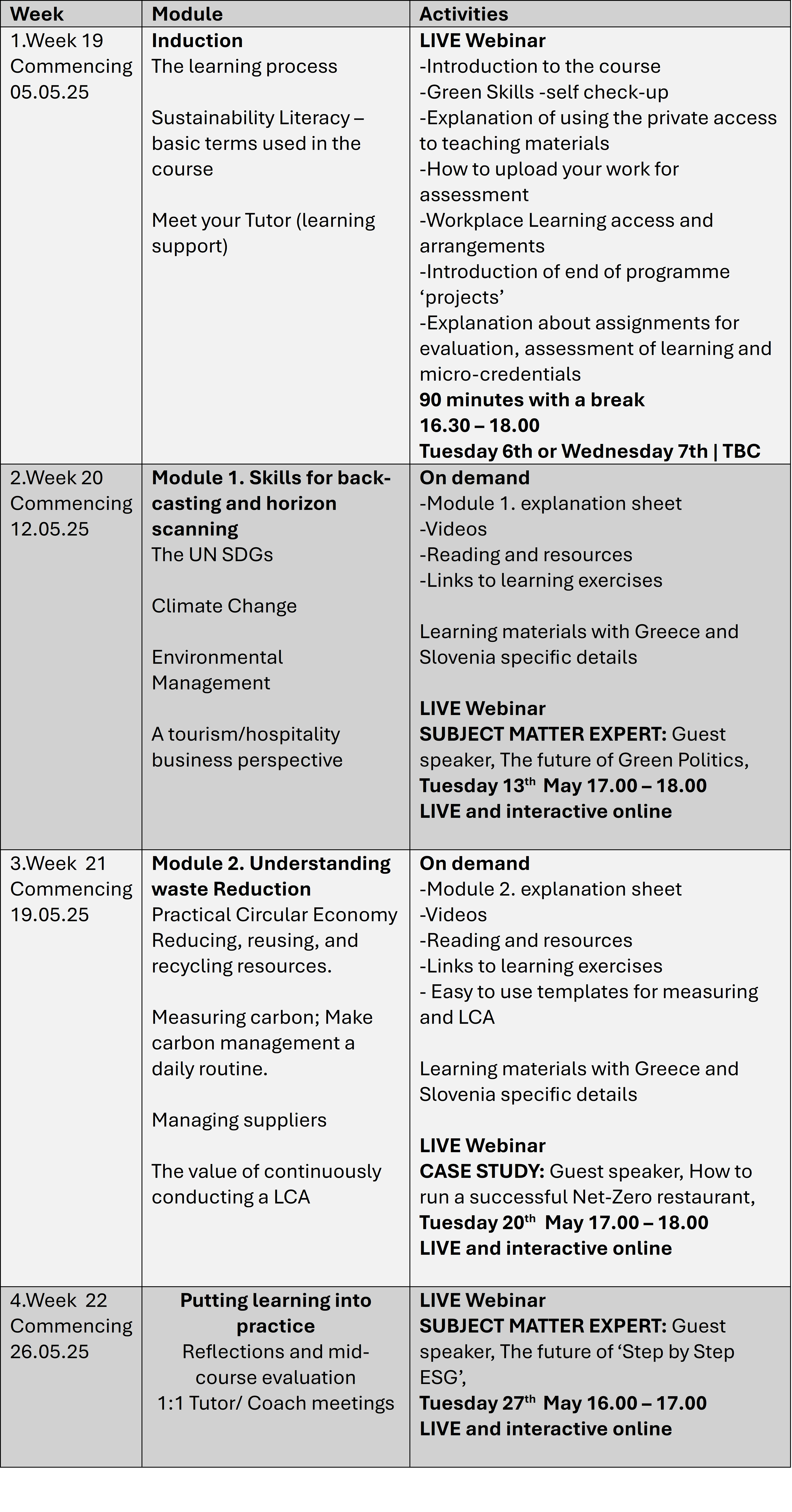
- The programme will start with a ‘live’, online interactive welcome and induction session to ‘meet the tutors’ and an explanation of how to access the teaching materials and submit course work for assessment.
- 4 core teaching modules will be available online and on demand. Each module will only become ‘open’ from the date that the module is scheduled to start.
- Each module has multiple ‘elements’/ ‘topics’, related to learning specific KSBs, which can be selected according to workplace role and geographical location. Some elements are optional.
- The online modules are supported by additional ‘special extras’ live, interactive webinars with tourism and hospitality practitioners, guest speakers from Greece and Slovenia. These sessions will be recorded, saved on YouTube and translated with subtitles added if needed.

New KSBs learned include those requested through the GenNZ survey and focus groups, plus ‘green skills’ in tourism (Finland) identified by Renfors, (2024):
- Future thinking/ horizon scanning – SKILL
- Sustainability Communications (Green Marketing) – SKILL
- Sustainability Communications (Customer engagement) KNOWLEDGE and SKILL
- Critical thinking – SKILL
- Decision making – SKILL
- Collaboration – Partnerships - SKILL
- Understanding compliance / laws regulations - KNOWLEDGE
- Step by step ESG – SKILL
- Monitoring and evaluation (includes carbon counting) KNOWLEDGE and SKILL
- Economic benefits of going green - KNOWLEDGE and SKILL and BEHAVIOUR
Transversal skills Include those identified in MiC4VET Erasmus+ KA220-VET – Cooperation partnerships in vocational education and training project (2022-2024):
- Intercultural skills & global awareness
- Flexibility & adaptability
- Strategical & innovative thinking
- Organization & time management
- Decision making
- Teamwork
- Empathy
- Problem-solving
We are pleased to introduce your GenNZ teaching, evaluation and support team! For more information about all of our facilitators and guest speakers

Prof. Thanasis Spyriadis
Thanasis is an Assistant Professor at the Department of Economics, University of Crete. He holds a PhD in performance evaluation of tourism development organisations (DMOs) and a MSc in Tourism Management and Marketing from Bournemouth University. Thanasis is certified as a UN Evaluator (ILO) and serves on the UoC Department of Economics Erasmus committee.
For the Erasmus+ GenNZ Summer School he takes up multiple roles of co-facilitator of the live sessions as well as assessor and evaluator for the learning elements, and also the quality of the full project.

Andreas Karadakis
Andreas is anInternational Development Advocate with skills and expertise in EU Project Management, based in Athens. He has a wide experience in international development and policy making, working in initiatives from Germany to Zimbabwe with diverse cultural insights towards changemaking. He has a BSc in Political Science and International Relations and a MSc in International Development Studies: Sustainability, Participation and Innovation at the Université Grenoble Alpes. For the Erasmus+ GenNZ Summer School, Andreas will be the first guest speaker and discusses the future of ‘green policy’ in the world and what it means for Greece.

Stella Diomantaraki – Sustainable Cretan Gastronomy Expert
With long standing experience in hospitality, food and beverage Stella always stays close to her Cretan roots and that includes traditional ‘sustainable practices’. Stella is an entrepreneur, a pioneer of NetZero hospitality and leading the way for others to follow. In her live, interactive webinar for GenNZ, she shares valuable insights, from her real life, practical experiences of running a busy restaurant in Chania, about managing a successful transition to NetZero hospitality.

Michael Spanos
Michael is Managing Director at Softone Global Sustain in Athens. Since 2006, he has been a pioneer of corporate sustainability reporting and ESG auditing in Greece, including creating the ESG reporting platform ‘Metron’ for the Greek Tourism Confederation (SETE). For the Erasmus+ GenNZ Summer School Michael will present a Subject Matter Expert webinar about the future of ESG reporting as an element of business strategy and transition planning towards a NetZero economy.

Petros Iliadis
Petros Iliadis is co-founder of Bee 4 Planet & the Melefsis beekeeping company, on the island of Spetses. With a background in Business Economics and Marketing and a telecoms specialist, Petros is beyond 'just a beekeeper'. For the Erasmus+ GenNZ Summer School Petros talks about innovative and successful ‘green’ products and services’ in tourism which are increasingly in demand.

Rosa Vásquez Espinoza, Ph.D.,
Rosa is a Chemical Biologist, National Geographic Explorer and Founder/Executive Director of Amazon Research Internacional. Of Peruvian-Andean and Amazonian descent, Rosa grew up learning about traditional medicine from her grandmother in their backyard’s "natural pharmacy". Today, Rosa travels to the most extreme environments of the Amazon Rainforest searching for the tiniest creatures, from microbes to stingless bees, to create big changes in the world.
For the Erasmus+ GenNZ Summer School, Rosa has recorded a video to watch ‘on-demand’, with her stories from the Amazon region and top tips and tools for engaging diverse people for making change happen… including ‘communication without words’.

Vincent Hoogstad
Vincent is a Veterinary physical therapist, anatomist and behavioural ecologist. He founded the ‘Animal Rehabilitation Crete’, where he works to rehabilitate injured animals (domestic and wild), and as a behavioural ecologist specialising in primates. From his grounding of a BSc in human physical therapy, he pivoted to re-skill as a researcher and teacher focussing on what can be learned from primates about pain management. He co-authored the book 'Monkey-business, pain in humans and other animals’ (2024), published in Dutch and English.
For the Erasmus+ GenNZ Summer School, Vincent has recorded a video to watch ‘on-demand’ about his experiences from his citizen- science style travel experience to Congo and a thought provoking, future model of ‘One Health; environmental health, human health and animal health’, how these 3 are inextricably linked and the role tourism can play in the future.

Nina Willems
Founder of Meraki Moments.
Nina will support our GenNZ learners, and guest speakers through this 8 weeks groundbreaking pilot teaching programme. Nina will help us to ensure the programme runs smoothly and on time! Nina is an associate of ESA
